In 1899, British photographer and inventor Edward Raymond Turner
patented the first color moving picture process, but it was so
complicated that it was never replicated. Following Turner's blueprints
and instructions for the process, researchers at the National Media Museum
digitally copied three frames of film taken from two rolls that were
discovered in 2009. The three frames were reconstructed in Photoshop
with red, green, and blue filters, similar to how they would have been
using Turner's original equipment through the use of colored gels.
As explained in the National
Media Museum's video, each frame of the original film had to be
re-photographed three times with each colored filter (RGB) and compiled
into the final product, which took about three years, thanks to federal
and private funding. The footage was then unveiled to the media for the
first time in 110 years — possibly for the first time ever.
The Hire is a series of short films made by BMW together with some of the worlds best directors. Beat the Devil - starring Clive Owen, Gary Oldman, James Brown, Danny Trejo, Marilyn Manson and based on a concept by David Fincher. Featuring the BMW Z4. Directed by Tony Scott.
"Halber Mensch" (aka "1/2 Mensch") is a
1986 film by Japanese director Sogo Ishii with German band Einstürzende
Neubauten. It was originally released on VHS, and re-released on DVD in
2005. The film's title comes from the album of the same name.
Einstürzende Neubauten were in their creative prime when
punk film pioneer
Sohgo Ishii shot this 58-minute document in Tokyo during the
band's world
tour in 1985.
Set mostly in a condemned factory/junkpile (the former
Nakamatsu Ironworks),
the film features a tormental troupe of butoh dancers, fire,
FM Einheit repairing
his shoe, micro photography, industrial textures, live
footage from their Korakuen
Hall arena shows, one of their guerilla street actions, lots
of beautiful destruction
and amazing music.
It's extremely, lyrically visual, perhaps because Ishii
didn't feel the need to
hang everything on some skimpy plot this time and could just
let his camera do the talking.
Savage Messiah is a 1972 British biographical film of the
life of French sculptor Henri Gaudier-Brzeska, made by Russ-Arts and
distributed by MGM. It was directed and produced by Ken Russell with Harry Benn
as associate producer, from a screenplay by Christopher Logue, based on the
book Savage Messiah by H.S. Ede. Much of the content of Ede's book came from
letters sent between Henri Gaudier-Brzeska and his lover Sophie Brzeska. The
music score was by Michael Garrett (though music by Claude Debussy and
Alexander Scriabin was also used), and the cinematography by Dick Bush. The
sets were designed by Derek Jarman.
Starring: Dorothy Tutin, Scott Antony, Helen Mirren,
Lindsay Kemp, Peter Vaughan and Michael Gough.
Whore is a 1991 film and the last film by controversial British director and
screenwriter Ken Russell, starring actress Theresa Russell as a Los Angeles
prostitute. The film remains fairly rare as it has only been released on VHS as
of 2012. Below is a link to the view the full feature. Enjoy.
An interesting and amusing interview with Chilean surrealist filmmaker, Alejandro Jodorowsky (Fando and Lis, El Topo, The Holy Mountain, Santa Sangre) recorded at the ICA, London in December 2002 after a screening of Santa Sangre.
Santiago Álvarez Román (March 18, 1919– May 20, 1998) was a Cuban filmmaker. He wrote and directed many documentaries about Cuban and American culture. His "nervous montage" technique of using "found materials," such as Hollywood movie clips, cartoons, and photographs, is considered a precursor to the modern video clip. El Tigre Saltó y Mató, Pero Morirá…Morirá…(The Tiger Jumped and Killed but It Will Die, It Will Die...) is a documentary film directed by Santiago Alvarez Roman depicting the injustices committed in Chile during the 1970's under the fascist dictatorsip of General Augusto Pinochet. It features music by Chilean folk singers, Violeta Parra and Victor Jara. Shortly after the Chilean coup of 11 September 1973, Jara was arrested, tortured and ultimately shot to death with 44 bullet shots by machine gun fire. His body was later thrown out into the street of a shanty town in Santiago. The contrast between the themes of his songs, on love, peace and social justice and the brutal way in which he was murdered transformed Jara into a symbol of struggle for human rights and justice across Latin America.
Alvarez studied in the United States but in the mid-1940s returned to Cuba, where he worked as a music archivist in a television station and participated in Communist Party activities.After the Cuban Revolution he became a founding member of the Cuban Film Institute (ICAIC) and directed its weekly Latin American Newsreel.
One of his most famous works, the short Now (1964) about racial discrimination in the USA, mixed news photographs and musical clips featuring singer/actress Lena Horne. Other well-known works included the anti-imprerialist satire LBJ (1968) and 79 Springs (1969), a poetic tribute to Ho Chi Minh. In 1968, he collaborated with Octavio Getino and Fernando E. Solanas (members of Grupo Cine Liberación) on the four-hour documentary Hora de los hornos, about foreign imperialism in South America. Among the other subjects he explored in his film were the musical and cultural scene in Latin America and the dictatorships which gripped the region.
Director: Santiago Álvarez. Producer: Sergio San Pedro. Sound: Juan Demóstenes. Editor: Gloria Argüelles. Music: Víctor Jara and Violeta Parra. Graphics: Adalberto Hernández and Santiago Peñate. Trucas: Jorge Pucheaux and Eusebio Ortiz. 35mm. Black and White. 16 mins. 1973.
Despite the fact that De Hirsch's contributions to the avant-garde film film scene of the 1960's has been largely forgotten, her work remains a source of inspiration to the underground. She started out as a poet before switching over to film as a medium of expression. In an interview with Jonas Mekas on the making of Divinations she said, "I wanted badly to make an animated short and had no camera available. I did have some old, unused film stock and several roles of 16mm sound tape. So I used that- plus a variety of of discarded surgical instruments and the sharp edge of a screwdriver- by cutting, etching, and painting directly on both film and tape."
This is Hitchcock's second feature film and the only one that is considered a lost film, which means that no prints of the film are known to exist. Hitchcock himself considered it a mundane melodrama best forgotten, though fans naturally remain curious. In François Truffaut's book, Hitchcock / Truffaut, Alfred Hitchcock himself described the film as "awful" and said he was "not sorry there are no known prints". Film historian J. Lary Kuhns, however, states in the book Hitchcock's Notebooks by Dan Auiler that one contemporary writer called The Mountain Eagle far superior to The Lodger.
Exteriors were filmed in Obergurgl, Austria. The Austrian Tyrol stood in for the mountains and hollows of Kentucky. Bad weather during the shooting was a constant source of trouble.
Although it was Hitchcock's second completed film, due to the runaway success of The Lodger, it was released three months after it.
Several surviving stills are reproduced in François Truffaut's book. More stills have recently been found to exist, many of which are reproduced in Dan Auiler's book. A lobby card (illustrated above right) for the film was found at a flea market in Rowley, Massachusetts. It was found in a box of broken frames and was being used as backing for the picture of another dog. The dog's significance in the film remains a mystery. It may have been used to assist Edward in fleeing the village or to help film's hero, John Fulton, during his escape from prison or return to the village seeking a doctor.
Although the film was reportedly released in the United States as Fear o' God, the title on the surviving U.S. lobby card seems to contradict this. Film historian J. Larry Kuhns claims the film was never released under that title.
The film is set in Kentucky. J. P. Pettigrew's (Bernhard Goetzke) wife died giving birth to his son Edward (John F. Hamilton) who was born a cripple. Pettigrew hates John ("Fear o' God") Fulton (Malcolm Keen) who also loved Pettigrew's wife. Pettigrew sees his now grown son making love to schoolteacher Beatrice (Nita Naldi) and seeks her out. During a discussion of her relationship to his son he attempts to take her in his arms but Beatrice rejects his advances. Pettigrew's son Edward sees this and flees the village.
Pettigrew is incensed at both Beatrice's rejection and the loss of his son. He attempts to have Beatrice arrested as a wanton harlot. John forestalls Pettigrew's plan by marrying Beatrice and taking her to his cabin where they fall in love. Beatrice becomes pregnant. Pettigrew seeks revenge by having John thrown in prison for murdering his (missing) son.
A year later John breaks out of prison and attempts to flee with Beatrice and their child but Beatrice falls ill and John must return to the village for a doctor. There he finds Edward has reappeared. His affairs are now cleared up and he is legally free from the charge of murder. Pettigrew is subsequently accidentally shot and no longer a threat to John and his family.
This animation shows interior of Tglad's Mandelbox fractal (scale = -2). Animation was rendered by Krzysztof Marczak using his program http://sourceforge.net/projects/mande...
This is a collection of very early color film tests by Kodak.To provide context, the first full length color feature film did not appear until 13-years later (Becky Sharp). Music (added): Killer Tracks CD entitled: KT223 (Inspire). First track used is called "Breath," the second is called "Kindle.""
In these newly preserved tests, made in 1922 at the Paragon Studios in Fort Lee, New Jersey, actress Mae Murray appears almost translucent, her flesh a pale white that is reminiscent of perfectly sculpted marble, enhanced with touches of color to her lips, eyes, and hair. She is joined by actress Hope Hampton modeling costumes from The Light in the Dark (1922), which contained the first commercial use of Two-Color Kodachrome in a feature film. Ziegfeld Follies actress Mary Eaton and an unidentified woman and child also appear.George Eastman House is the repository for many of the early tests made by the Eastman Kodak Company of their various motion picture film stocks and color processes. The Two-Color Kodachrome Process was an attempt to bring natural lifelike colors to the screen through the photochemical method in a subtractive color system. First tests on the Two-Color Kodachrome Process were begun in late 1914. Shot with a dual-lens camera, the process recorded filtered images on black/white negative stock, then made black/white separation positives. The final prints were actually produced by bleaching and tanning a double-coated duplicate negative (made from the positive separations), then dyeing the emulsion green/blue on one side and red on the other. Combined they created a rather ethereal palette of hues."Of Note:This footage is from the George Eastman House collections. Preservation was completed by the museum's Motion Picture Department, a project of Sabrina Negri, a student in Eastman House's L. Jeffrey Selznick School of Film Preservation and a recipient of the Haghefilm Foundation Fellowship.
So without further adieu, here from 1922, a full 7 years before the first Academy Award ceremony, is some of the earliest color motion pictures that you will ever see.
The Art of Mirrors is an abstract film made in 1973 by director, Derek Jarman. The film, shot in super 8 features figures moving in the foreground and background of an empty space holding mirrors which occasionally flash in the lens of the camera.The images portrayed in the film are reminiscent of Jarman's Abstract Landscape paintings of the same period. In his diary Jarman wrote of this film, 'this is only something that could only be done on a Super 8 camera, with it's built in meters and effects.' The film's title was reworked in the script for 'Dr Dee The Art Of Mirrors and The Summoning Of Angels' in 1975.
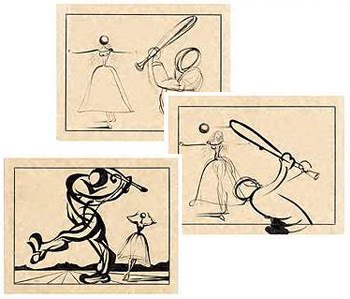
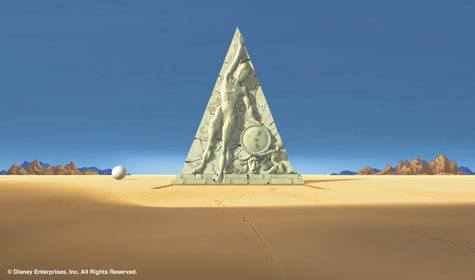
Image# 1: Walt Disney admires Dali's painting. Image# 2-3: Dali and Disney. Image# 4-5: Dali. Image# 6-17: Dali's conceptual art for Destino. Image# 18-19: Disney production art for the film. Image# 20-40: scenes from the film. Image # 41-42: Roy Disney