Image# 1: Walt Disney admires Dali's painting. Image# 2-3: Dali and Disney. Image# 4-5: Dali. Image# 6-17: Dali's conceptual art for Destino. Image# 18-19: Disney production art for the film. Image# 20-40: scenes from the film. Image # 41-42: Roy Disney
Destino is a short animated cartoon released in 2003 by The Walt Disney Company. Destino is unique in that its production originally began in 1945, 58 years before its eventual completion. The project was a collaboration between AmericananimatorWalt Disney and SpanishpainterSalvador Dalí, and features music written by Mexicansongwriter Armando Dominguez and performed by Dora Luz. Destino (the Galician, Spanish, Portuguese and Italian word for "destiny") was storyboarded by Disney studio artist John Hench and artist Salvador Dalí for eight months in late 1945 and 1946; however, financial concerns caused Disney to cease production. The Walt Disney Company, then Walt Disney Studios, was plagued by many financial woes in the World War II era. Hench compiled a short animation test of about 18 seconds in the hopes of rekindling Disney's interest in the project, but the production was no longer deemed financially viable and put on indefinite hiatus.
In 1999, Walt Disney's nephew Roy Edward Disney, while working on Fantasia 2000, unearthed the dormant project and decided to bring it back to life. Disney Studios France, the company's small Parisian production department, was brought on board to complete the project. The short was produced by Baker Bloodworth and directed by French animator Dominique Monfrey in his first directorial role. A team of approximately 25 animators deciphered Dalí and Hench's cryptic storyboards (with a little help from the journals of Dalí's wife Gala Dalí and guidance from Hench himself), and finished Destino's production. The end result is mostly traditional animation, including Hench's original footage, but it also contains some computer animation. The 18 second original footage that is included in the finished product is the segment with the two tortoises.
The finished product was meant to be part of the canceled film Fantasia 2006 but when the short was completed after the film's cancellation, Destino, as well as three other completed segments (The Little Matchgirl, One by One, and Lorenzo), was changed to a short subject.
Destino premiered on June 2, 2003 at the Annecy International Animated Film Festival in Annecy, France. The six-minute short follows the love story of Chronos and the ill-fated love he has for a mortal female. The story continues as the female dances through surreal scenery inspired by Dalí's paintings. There is no dialogue, but the sound track features a song by the Mexican composer Armando Dominguez.
The short film was very well received; it won many awards and was nominated for a 2003 Academy Award for Animated Short Film. Destino was released theatrically in a very limited release with the film Calendar Girls. As of 2010, Disney has confirmed releasing the short with "their next feature release as a short," but Destino was never attached to any of Disney's releases in 2008 or the following year.
The film was shown as part of the exhibition Dali & Film at Tate Modern from June to September 2007, as part of the Dali exhibit at the LA County Museum of Art from October 2007 to January 2008, and at an exhibition at New York's Museum of Modern Art called Dalí: Painting and Film from June to September 2008 as well as at an exhibit at the Dali Museum in St. Petersburg, Florida, in 2008. In mid-2009 it has had exposure in Melbourne, Australia at the National Gallery of Victoria through the Dali Exhibition 'Liquid Desire,' and from late 2009 through April 2010 at the Dayton Art Institute in Dayton, Ohio, in an exhibit entitled Dali and Disney: The Art and Animation of Destino.
From the January 20, 2008 press release:
Destino began in 1946 as a collaboration between Walt Disney and the famed surrealist painter Salvador Dali. A first-hand example of Disney's interest in avant garde and experimental work in animation, Destino was to be awash with Dali's iconic melting clocks, marching ants and floating eyeballs. However, Destino was not completed at that time. In 2003 it was rediscovered by Walt’s nephew, Roy E. Disney, who took on the challenge of bringing the creation of these two great artists to fruition. In addition to the completed Destino, this exciting addition to the Walt Disney Treasures line also includes an all-new feature-length documentary that examines the surprising partnership between Dali and Disney plus two new featurettes; "The Disney That Almost Was," an examination of the studio's unfinished projects; and "Encounters with Walt," which addresses the surprisingly diverse group of celebrities and artists who were attracted to Walt Disney's early work.
The French documentary series, Cinéastes de Notre Temps aired this episode on April 4, 1964 which focuses on the early career of exiled surrealist filmmaker, Luis Bunuel.
L'Âge d'Or (French pronunciation: [lɑʒ dɔʁ], English: The Golden Age) is a 1930 surrealist film directed by Luis Buñuel and written by Buñuel and Salvador Dalí, who was also credited as co-creator of Luis Buñuel's surrealist film, Un Chien Andalou. L’age d’or was performed at Studio 28 in Paris in 1930 and is partly based on the Marquis de Sade's 120 Days of Sodom. The film became Buñuel's solo project after a falling-out he had with Dali before filming began. During this film, he worked around his technical ignorance by filming mostly in sequence and using nearly every foot of film that he shot. L'Âge d'or was read to be an attack on Catholicism, and thus, precipitated an even larger scandal than Un chien andalou. The right-wing press criticized the film and the police placed a ban on it that lasted 50 years. Fascist and anti-Semitic groups staged a stink bomb and ink-throwing riot in the Paris theater where it was shown. Although negative aspects of society were being thrown into the life of Dalí and obviously affecting the success of his artwork, it did not hold him back from expressing his own ideas and beliefs in his art and Buñuel eventually would come to be regarded as one of the finest directors in the history of cinema. Both of these films, Un Chien Andalou and L’age d’or, have had a tremendous impact on the independent surrealist film movement.
"If Un Chien Andalou stands as the supreme record of Surrealism's adventures into the realm of the unconscious, then L'Âge d'or is perhaps the most trenchant and implacable expression of its revolutionary intent."
-Robert Short "The Age of Gold: Surrealist Cinema, Persistence of Vision" Vol. 3, 2002
The film cost a million francs to produce and was financed by the nobleman Vicomte Charles de Noailles, who beginning in 1928 commissioned a film every year for the birthday of his wife Marie-Laure de Noailles. When it was first released, there was a storm of protest. The film premiered at Studio 28 in Paris on 29 November 1930 after receiving its permit from the Board of Censors. In order to get the permit, Buñuel had to present the film to the Board as the dream of a madman.
On 3 December 1930, a group of incensed members of the fascist League of Patriots threw ink at the screen, assaulted members of the audience, and destroyed art works by Dalí, Joan Miró, Man Ray, Yves Tanguy and others on display in the lobby.
On 10 December, the Prefect of Police of Paris, Jean Chiappe, arranged to have the film banned after the Board of Censors reviewed the film. A contemporary Spanish newspaper condemned the film as “...the most repulsive corruption of our age... the new poison which Judaism, masonry, and rabid, revolutionary sectarianism want to use in order to corrupt the people.”
The Noailles family pulled the film from distribution for nearly 50 years. In 1933, it was screened at the Museum of Modern Art in New York City, but the film did not have its official United States premiere until 1–15 November 1979 at the Roxie Cinema in San Francisco.
The film consists of a series of tightly interlinked vignettes, the most sustained of which details the story of a man and a woman who are passionately in love. Their attempts to consummate their passion are constantly thwarted, by their families, by the Church and bourgeois society in general. In one notable scene, the young girl passionately fellates the toe of a religious statue.
In the final vignette, the place card narration tells of an orgy of 120 days of depraved acts (a reference to the Marquis de Sade's 120 Days of Sodom) and tells us that the survivors of the orgy are ready to emerge. From the door of a castle emerges the Duc de Blangis, who strongly resembles Christ, with his long robes and beard. When a young girl runs out of the castle, the Duc comforts the girl, before taking her back into the castle. A scream is heard and the Duc emerges again, his beard mysteriously vanished. The film suddenly cuts to its final image, with the scalps of the women flapping in the wind on a crucifix, accompanied by jovial music. It has been suggested that this, along with scenes of violent expression earlier in the film as the lovestruck protagonist is manhandled along by two enforcers, may suggest that the film's message is that sexual repression, whether propagated by civil bourgeois society or by the church, breeds violence. This scene is alluded to in the opening sequence, which is an excerpt from a short science film about a scorpion. There we are informed that scorpions have five prismatic articulations, culminating in a sting.
CAST: * Gaston Modot as The Man * Lya Lys as the Young Girl * Caridad de Laberdesque as a Chambermaid and Little Girl * Max Ernst as the Leader of men in cottage * Josep Llorens Artigas as (Governor) * Lionel Salem as Duke of Blangis * Germaine Noizet as Marquise * Duchange as Conductor
The film's illustrations were created by Luis Ortiz Rosales.
There are two sources below from which you can watch the film. The first window below offers the full film uncut. The rest of the windows below that feature the film cut into segments. The segmented version appears to be higher resolution. Enjoy!
Photo#1 : A perspective drawing by Sant'Elia, 1914
Photo#2 : Perspective drawing from La Citta Nuova, 1914.
Photo#3 : Example of Futurist architecture
Antonio Sant'Elia (April 30, 1888 - October 10, 1916) was an extremely influential Italianarchitect.
Antonio Sant'Elia was born in Como, Lombardy. A builder by training, he opened a design office in Milan in 1912 and became involved with the Futurist movement. Between 1912 and 1914, influenced by industrial cities of the United Statesand the Viennese architects Otto Wagner and Adolf Loos, he began a series of design drawings for a futurist Città Nuova and the ("New City") that was conceived as symbolic of a new age.
Many of these drawings were displayed at the only exhibition of the Nuove Tendenze group (of which he was a member) exhibition in May/June 1914 at the "Famiglia Artistica" gallery. Today, some of these drawings are on permanent display at Como's art gallery (Pinacoteca). (They used to be in the Villa Olmo)
The manifestoFuturist Architecture was published in August 1914, supposedly by Sant'Elia, though this is subject to debate. In it the author stated that "the decorative value of Futurist architecture depends solely on the use and original arrangement of raw or bare or violently colored materials". As described in this manifesto, his designs featured bold groupings and large-scale disposition of planes and masses creating a heroic industrial expressionism. His vision was for a highly industrialised and mechanized city of the future, which he saw not as a mass of individual buildings but a vast, multi-level, interconnected and integrated urban conurbation designed around the "life" of the city. His extremely influential designs featured vast monolithic skyscraper buildings with terraces, bridges and aerial walkways that embodied the sheer excitement of modern architecture and technology.
A nationalist as well as an irredentist, Sant'Elia joined the Italian army as Italy entered World War I in 1915. He was killed during the Battles of the Isonzo, near Monfalcone. Most of his designs were never built, but his futurist vision has influenced many architects, artists and designers.
Although he was not the first to generate sound with a computer (an Australian CSIRAC computer played tunes as early as 1951), Mathews fathered generations of digital music tools. He describes his work in parental terms in this excerpt from "Horizons in Computer Music," March 8-9, 1997, Indiana University:
"Computer performance of music was born in 1957 when an IBM 704 in NYC played a 17 second composition on the Music I program which I wrote. The timbres and notes were not inspiring, but the technical breakthrough is still reverberating. Music I led me to Music II through V. A host of others wrote Music 10, Music 360, Music 15, Csound and Cmix. Many exciting pieces are now performed digitally. The IBM 704 and its siblings were strictly studio machines--they were far too slow to synthesize music in real-time. Chowning'sFM algorithms and the advent of fast, inexpensive, digital chips made real-time possible, and equally important, made it affordable."
"Starting with the Groove program in 1970, my interests have focused on live performance and what a computer can do to aid a performer. I made a controller, the radio-baton, plus a program, the conductor program, to provide new ways for interpreting and performing traditional scores. In addition to contemporary composers, these proved attractive to soloists as a way of playing orchestral accompaniments. Singers often prefer to play their own accompaniments. Recently I have added improvisational options which make it easy to write compositional algorithms. These can involve precomposed sequences, random functions, and live performance gestures. The algorithms are written in the C language. We have taught a course in this area to Stanford undergraduates for two years. To our happy surprise, the students liked learning and using C. Primarily I believe it gives them a feeling of complete power to command the computer to do anything it is capable of doing."
In 1961, Mathews arranged the accompaniment of the song Daisy Bell for an uncanny performance by computer-synthesized human voice, using technology developed by John Kelly of Bell Laboratories and others. Author Arthur C. Clarke was coincidentally visiting friend and colleague John Pierce at the Bell LabsMurray Hill facility at the time of this remarkable speech synthesis demonstration and was so impressed that he later told Stanley Kubrick to use it in 2001: A Space Odyssey, in the climactic scene where the HAL 9000 computer sings while his cognitive functions are disabled.
Mathews directed the Acoustical and Behavioral Research Center at Bell Laboratories from 1962 to 1985, which carried out research in speech communication, visual communication, human memory and learning, programmed instruction, analysis of subjective opinions, physical acoustics, and industrial robotics. From 1974 to 1980 he was the Scientific Advisor to the Institute de Recherche et Coordination Acoustique/Musique (IRCAM), Paris, France, and since 1987 has been Professor of Music (Research) at Stanford University. He served as the Master of Ceremonies for the concert program of NIME-01, the inaugural conference on New interfaces for musical expression.
The Max portion of the software package Max/MSP is named after him (the MSP portion is named for Miller Puckette, currently teaching at UC- San Diego).
"Daisy Bell" was composed by Harry Dacre in 1892. In 1961, the IBM 7094 became the first computer to sing, singing the song Daisy Bell. Vocals were programmed by John Kelly and Carol Lockbaum and the accompaniment was programmed by Max Mathews. This performance was the inspiration for a similar scene in 2001: A Space Odyssey. Below the pictures there is a video clip you can play with the audio recording. Enjoy. Daisy, Daisy, give me your answer do I'm half crazy all for the love of you It won't be a stylish marriage I can't afford a carriage But you'll look sweet upon the seat Of a bicycle built for two. PHOTO #1: IBM 7094 Emergency Power Off Switch PHOTO #2: IBM 7094 with operator, John Szallasi PHOTO #3: IBM 7094 tape room PHOTO #4: IBM 7094 console PHOTO #5: Bob Sparks with IBM 7094 PHOTOS #6-10: Various Pictures of the IBM 7094


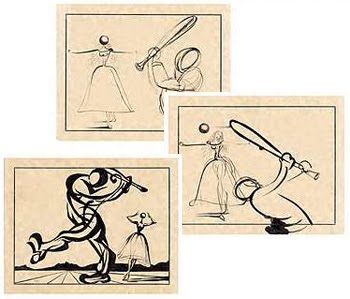


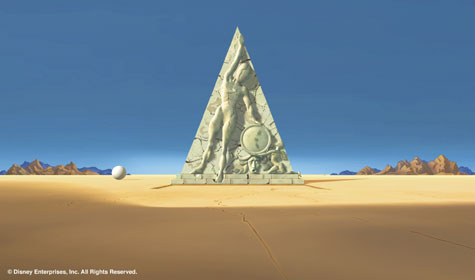


 Image# 2-3: Dali and Disney. Image# 4-5: Dali. Image# 6-17: Dali's conceptual art for Destino. Image# 18-19: Disney production art for the film. Image# 20-40: scenes from the film. Image # 41-42: Roy Disney


